CASE-OP001 · Commodity Intrusion on a Workstation
| Case | CASE-OP001 (purple-team operation OP-001) |
|---|---|
| Dates | 2026-09-22 to 2026-09-23 |
| Status | Closed: recovered and negative-validated |
| Host | WIN11-PB026 (10.10.2.8), disposable Windows 11 Pro, domain-joined |
| Account | PB026-Admin (local administrator) |
| Classification | Authorized emulation. Lab IPs and accounts are fictional. |
1. Bottom line up front
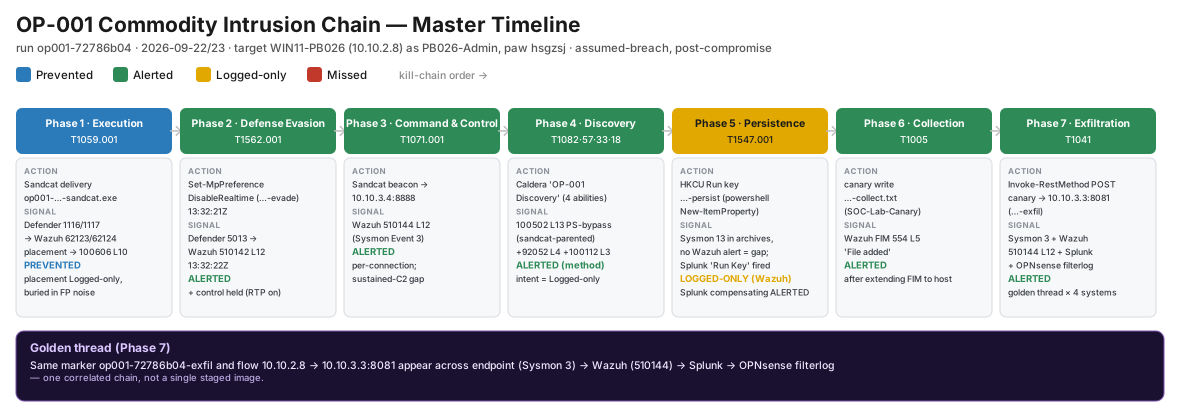
An intruder with administrator rights on one workstation ran a full attack chain: code execution, an attempt to weaken antivirus, a command-and-control (C2) channel, discovery, persistence, collection of a decoy file, and exfiltration of that file. Defender stopped the malware from being delivered at all, so the intruder had to be placed on the host deliberately (assumed breach). After that, the SOC alerted on 5 of 7 stages, but the investigation found four gaps, the most serious being that the malware's launch was buried in a noisy rule with 155 false positives a week. No data left the lab and no other host was affected. Top recommendation: tune out the noisy rule and add precise detections for persistence and long-running C2, which became the OP-004 work.
2. Disposition
- Verdict: True positive (authorized emulation)
- Severity: High. Administrator-level foothold with working C2 and exfiltration.
- Confidence: High. Every stage is confirmed by endpoint, SIEM and firewall evidence.
- ATT&CK: Execution T1059.001 · Defense Evasion T1562.001 · C2 T1071.001 · Discovery T1082, T1057, T1033, T1018 · Persistence T1547.001 · Collection T1005 · Exfiltration T1041
3. What happened
- Who: local administrator
PB026-Admin, controlled by a MITRE Caldera agent - What: a seven-stage intrusion, from execution through exfiltration
- Where: one workstation,
WIN11-PB026; C2 server and exfil receiver in the ATTACK zone - When: 2026-09-22 to 09-23
- How: a Caldera "Sandcat" agent driven over HTTP C2, running PowerShell with the execution policy bypassed
- Why (assessed): the behavior of a commodity intruder: survey the host, persist, take data out
4. Timeline
Stages are listed in the order they were run. Outcome key: 🟦 Prevented · 🟩 Alerted · 🟨 Logged-only · 🟥 Missed
| Stage | Action | What the SOC saw | Outcome |
|---|---|---|---|
| 1a Delivery | Agent dropped via PowerShell, twice (once with a folder exclusion) | Defender 1116/1117 → Wazuh 62123/62124: blocked by cloud reputation both times |
🟦 |
| 1b Placement | Agent started during a documented 2-minute protection exception | Only rule 100606 (L10), which fires ~155 times a week on OneDrive and updaters |
🟨 buried |
| 2 Defense evasion | Set-MpPreference tried to turn off real-time protection |
Tamper Protection blocked it; Event 5013 → Wazuh 510142 (L12) |
🟩 + 🟦 |
| 3 C2 | Agent beaconed to 10.10.3.4:8888 |
Wazuh 510144 (L12) on the first connection only |
🟩 |
| 4 Discovery | Four bounded discovery commands via the agent | 100502 (L13) PowerShell ExecutionPolicy Bypass: caught how it ran, not what it did |
🟩 |
| 5 Persistence | PowerShell wrote an HKCU Run value |
Wazuh silent. The Splunk search SOC - Suspicious Script Host Modifies Run Key fired |
🟨 Wazuh / 🟩 Splunk |
| 6 Collection | Decoy file written under C:\ProgramData\SOC-Lab-Canary |
Nothing at first: file monitoring wasn't deployed on this host. After adding it, Wazuh 554 (L5) |
🟩 after fix |
| 7 Exfiltration | PowerShell uploaded the decoy to 10.10.3.3:8081 |
Wazuh 510144 (L12), Sysmon Event 3, OPNsense pass record |
🟩 |
Evidence
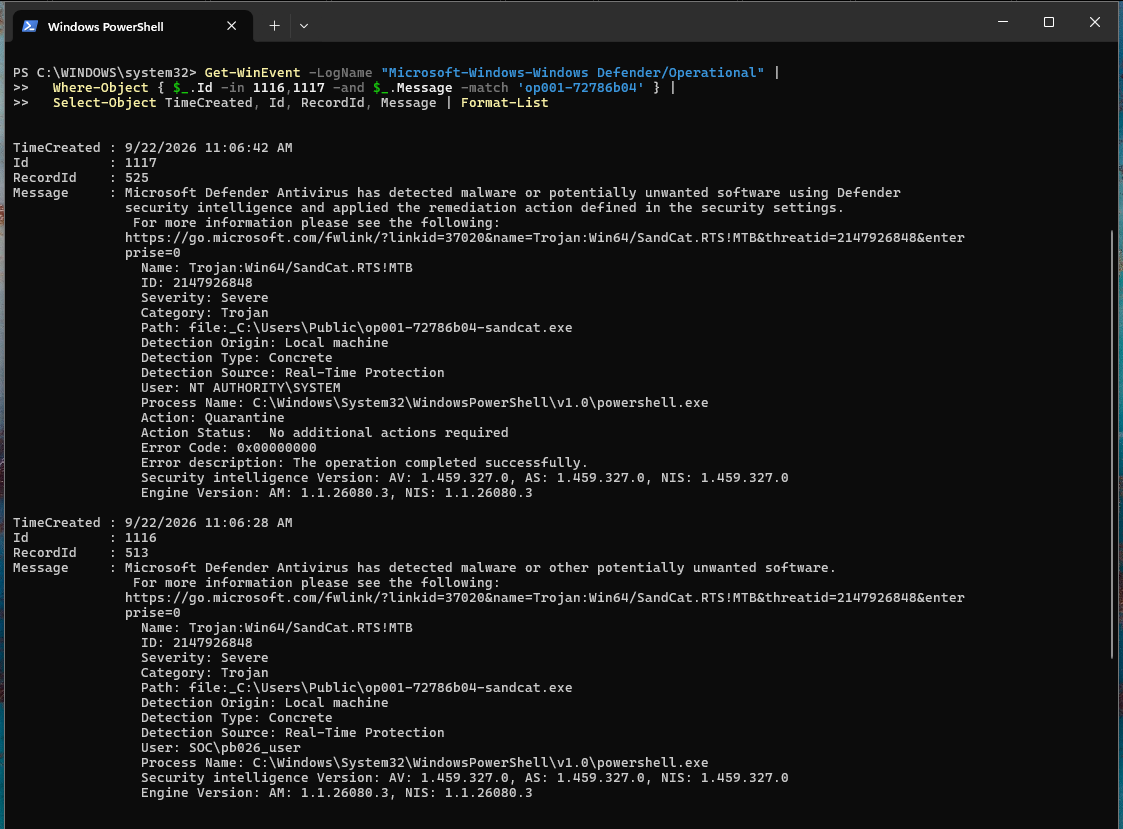
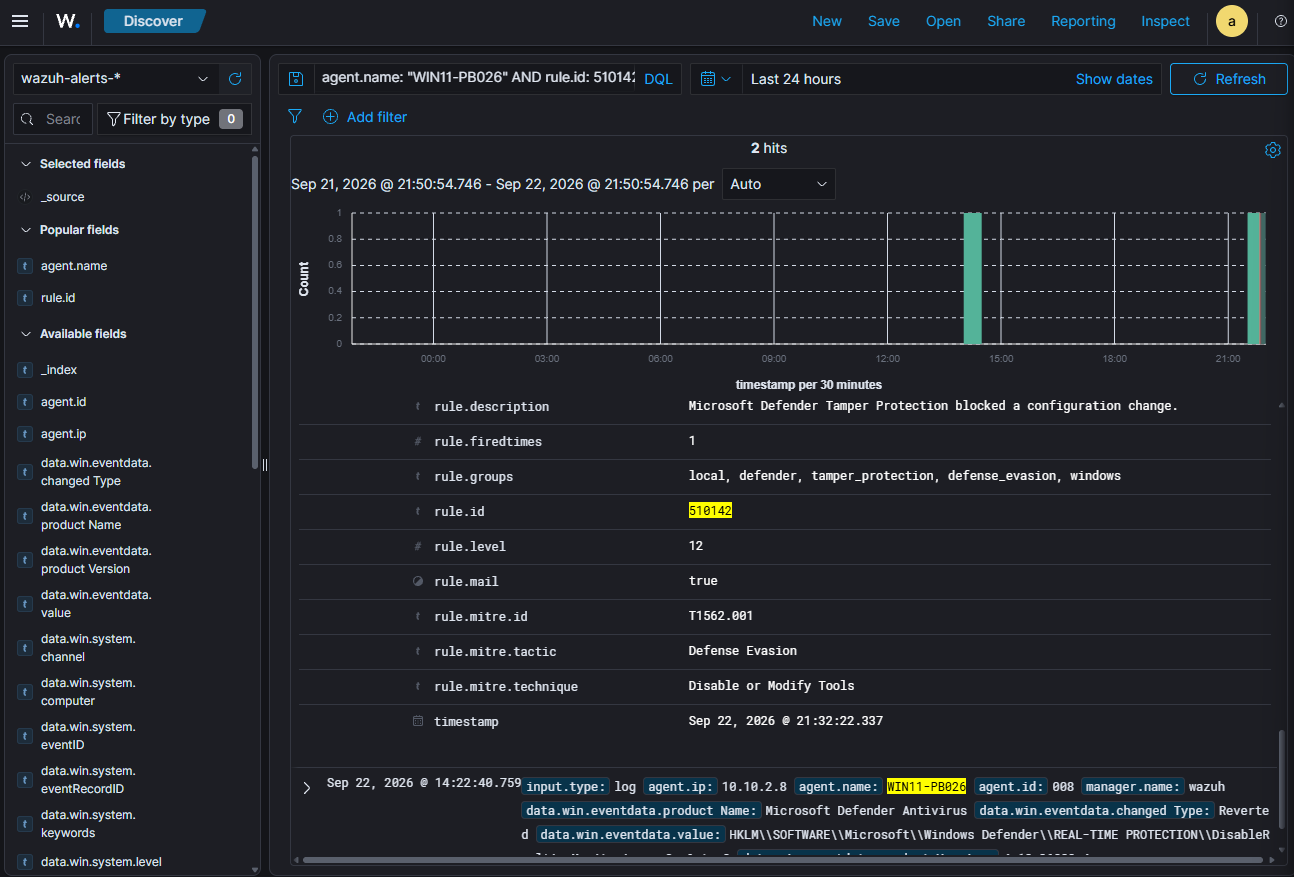
510142 (L12, T1562.001) when Tamper Protection blocked the change.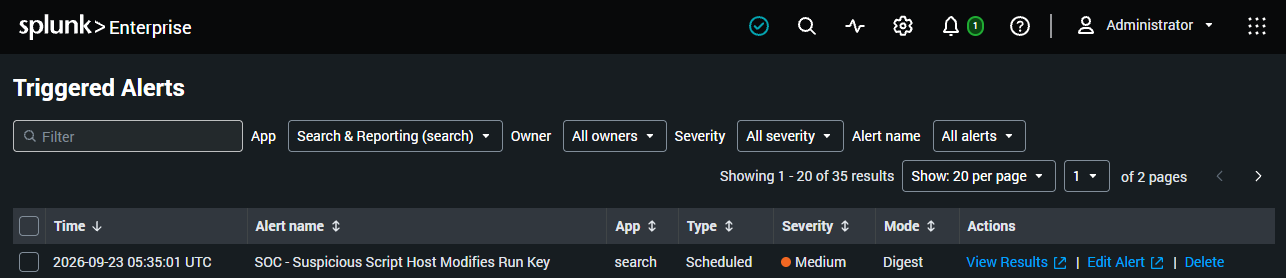
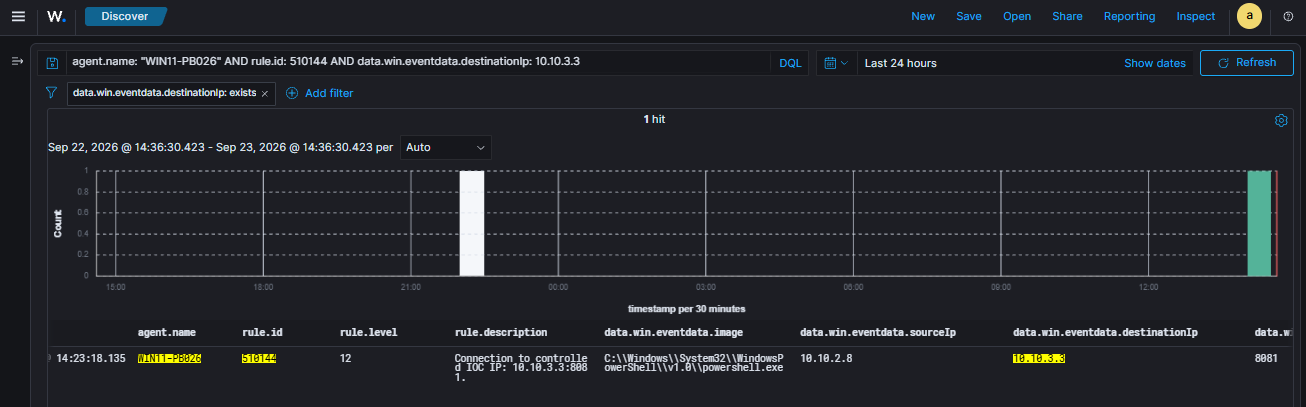
510144 (L12) on PowerShell connecting to the exfil receiver.5. Scope
- Affected: one workstation and one local administrator account.
- Not affected: the domain controller, other workstations and domain accounts. No lateral movement was attempted, and the only file collected was a decoy.
- Data out: one decoy file to a lab receiver.
6. Indicators
| Type | Value | Note |
|---|---|---|
| IP:port | 10.10.3.4:8888 |
C2 server (Caldera) |
| IP:port | 10.10.3.3:8081 |
Exfiltration receiver |
| File | op001-…-sandcat.exe in a user-writable staging folder |
Agent binary |
| Registry | HKCU\Software\Microsoft\Windows\CurrentVersion\Run\op001-…-persist |
Persistence |
| Path | C:\ProgramData\SOC-Lab-Canary\…collect.txt |
Decoy accessed |
7. Response
- Containment: withheld on purpose (disposable host, controlled activity). In production it would go through the lab's approval-gated SOAR path: TheHive case → signed Slack approval → scoped action.
- Recovery: agent, Run value, staging exclusion, decoy file and temporary firewall rules all removed; Caldera showed 0 agents and stayed at 0 (no re-registration). Real-time protection and Tamper Protection confirmed on.
- Negative validation: connections from the host to both lab addresses fail again.
8. Detection gaps and what happened to them
| Gap | Fix | Status |
|---|---|---|
| Malware launch hidden in a rule with ~155 false positives a week | Tune 100606; add a precise "unsigned exe from AppData launched by a script host" rule |
Backlog |
| PowerShell Run-key write not alerted by Wazuh | New Wazuh rule 510150 (any script host writing a Run key) |
✅ Fixed 2026-09-25, see detections |
| C2 alert fires on the first connection only | Beaconing detection based on timing, not just IOC matches | Backlog |
| File monitoring for the decoy only on one host | File monitoring built into every endpoint's baseline image; raise its severity | ✅ In the OP-002 endpoint baseline |
9. Analyst notes
- An alert isn't the same as a detection. Stage 1b technically raised an alert, but checking the rule's history showed it was mostly false positives, so it was scored as a gap, not a success.
- This was a guided run: attack and defense were run together. A blind re-run of OP-001, where the analyst investigates cold, is still to do.
- Assumed breach: the agent never beat Defender. Delivery was blocked, and the agent was placed through a short, documented exception that was reversed straight after.