Results
Two questions, answered with evidence: what did the SOC catch when attacked, and did the fixes hold up when tested cold?
1. What the operations found
Each phase of each operation was scored by its best outcome.
| Operation | 🟦 Prevented | 🟩 Alerted | 🟨 Logged-only | 🟥 Missed | Headline |
|---|---|---|---|---|---|
| OP-001 Commodity intrusion | 1 | 5 | 1 | 0 | Loud attacker: mostly caught, but the malware launch was buried in a noisy rule |
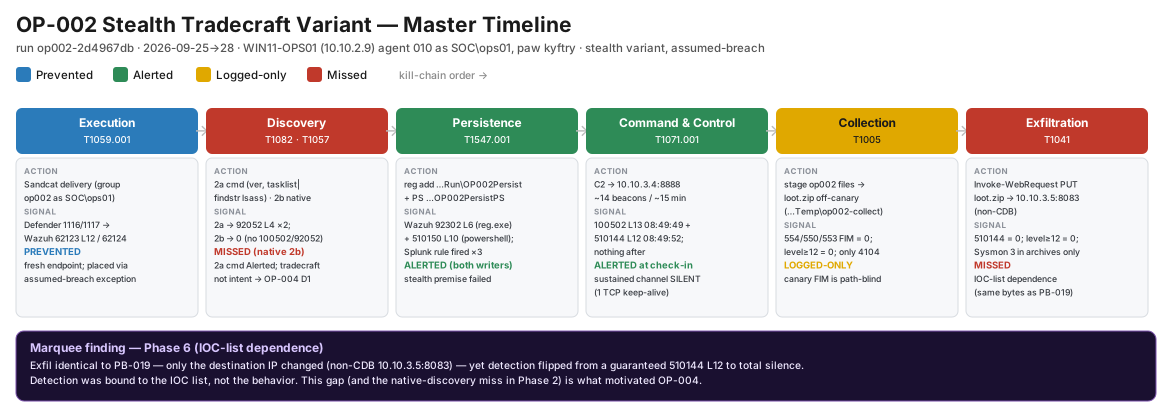
| OP-002 Quiet variant | 1 | 5 (1 buried) | 1 | 3 | Same attack done quietly: native discovery, sustained C2 and exfiltration slipped through |
| OP-003 Lateral movement | 2 | 0 | 0 | 1 | The hop between workstations was invisible, but execution on the target was blocked |
2. The fixes (OP-004)
| Gap | Detection built | Validated before enabling |
|---|---|---|
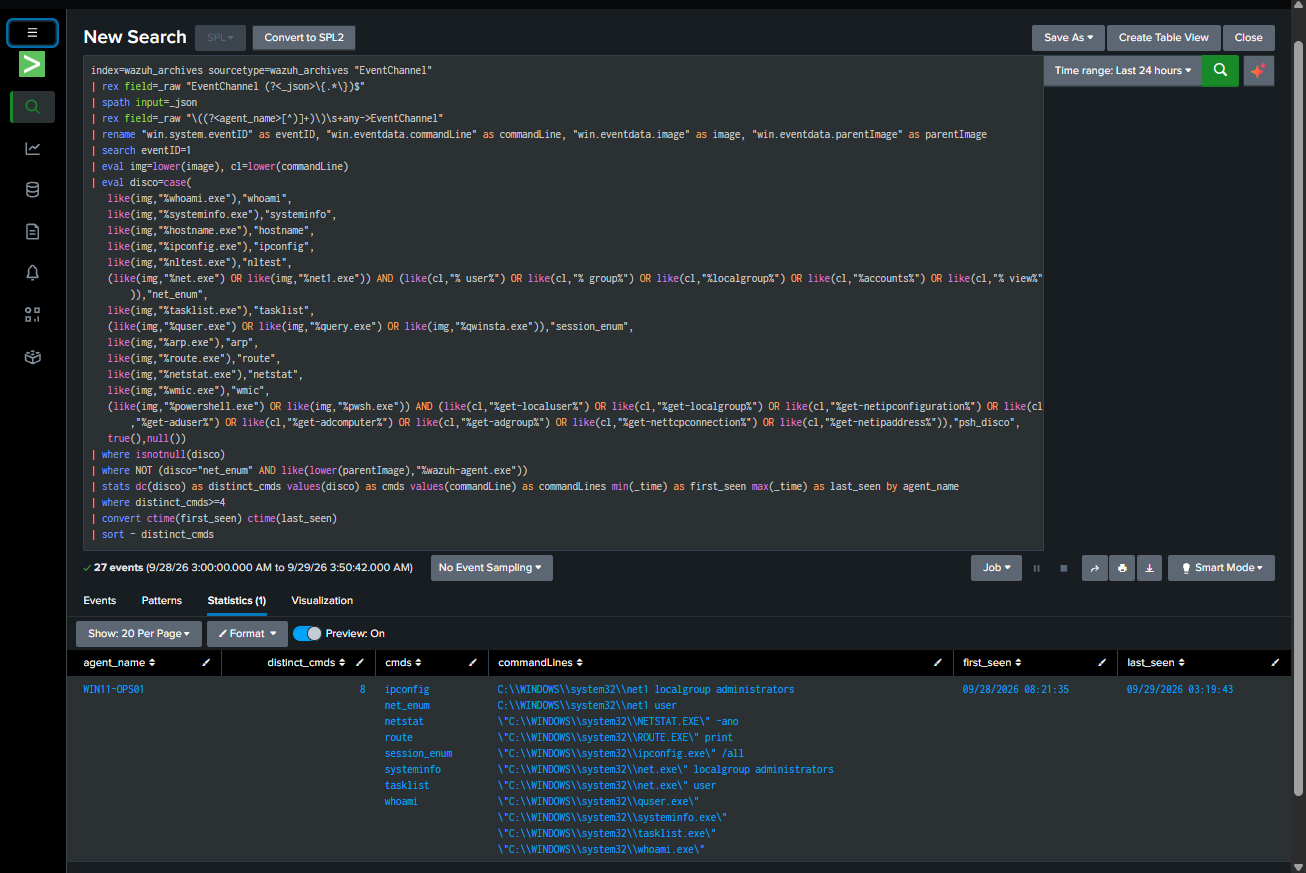
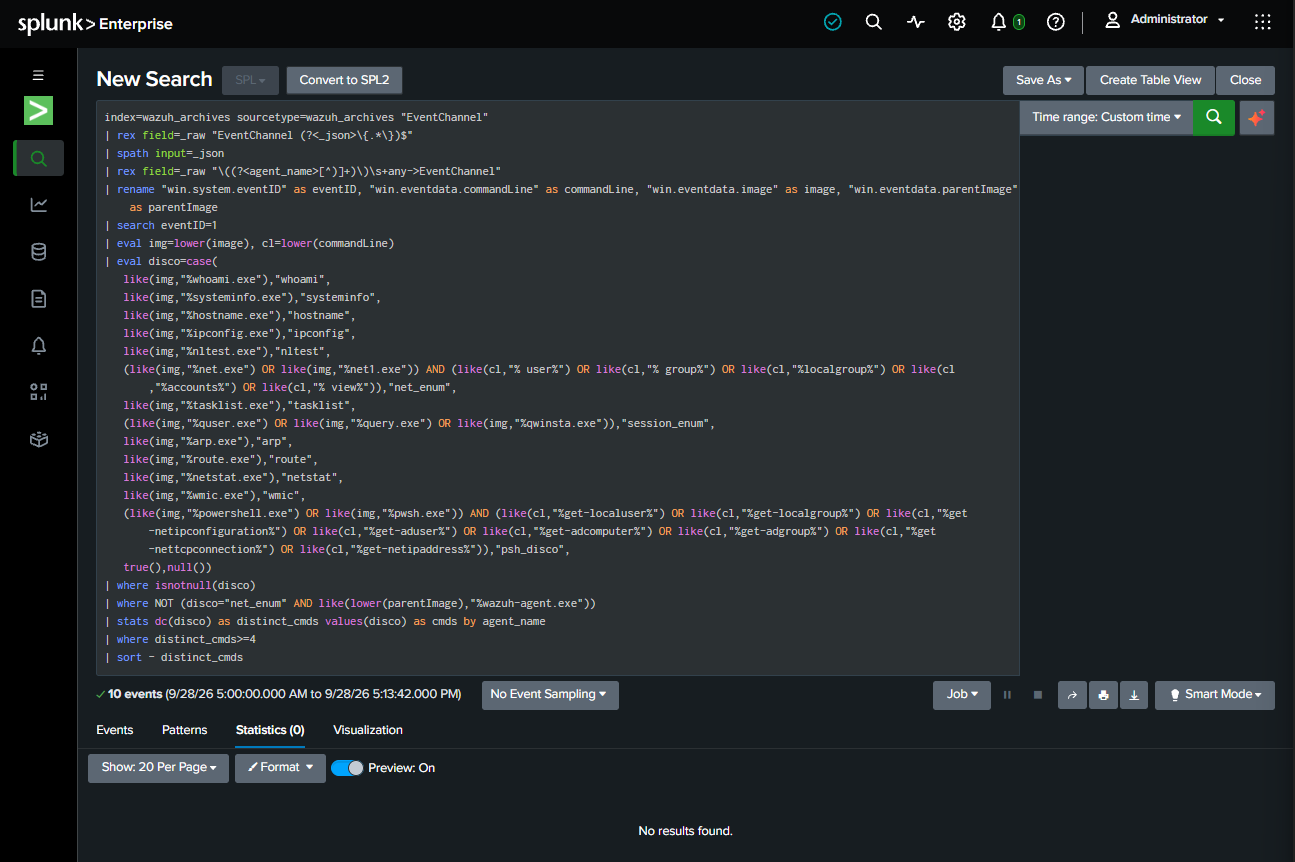
| Native discovery invisible (OP-002) | D1 · 4+ discovery tools on one host in 10 min | Fired at 8 tools on a replayed burst; busiest normal window on any host = 1 |
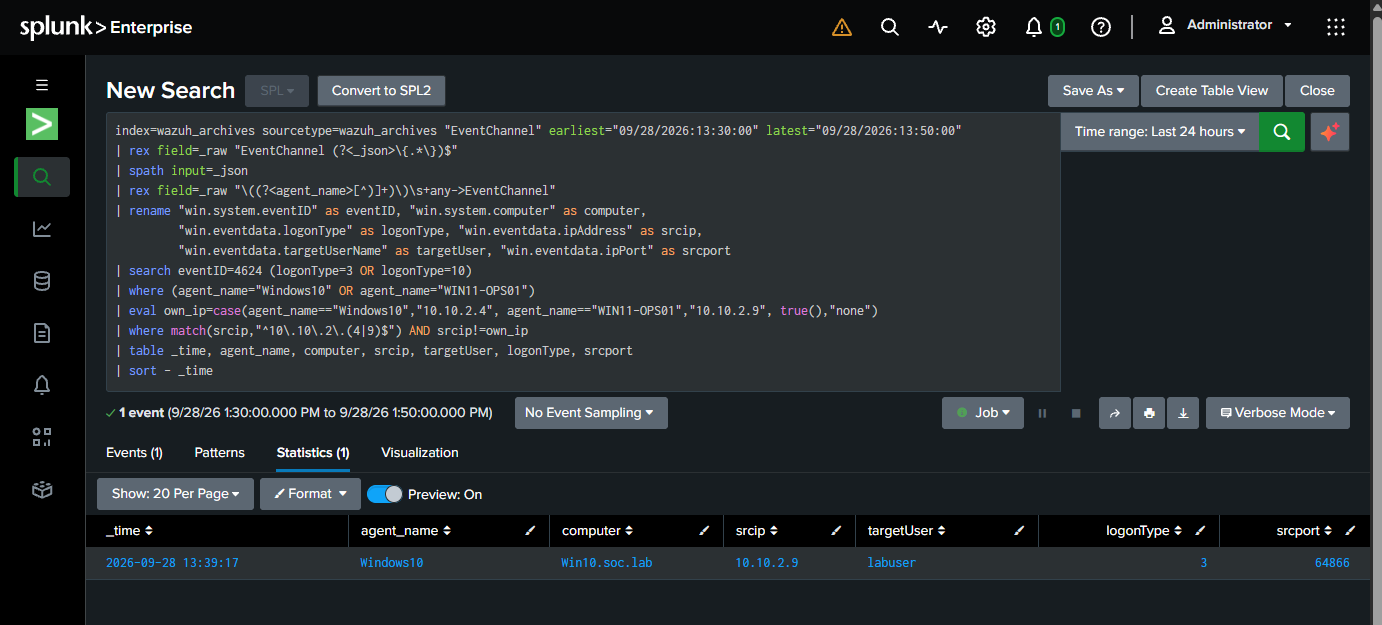
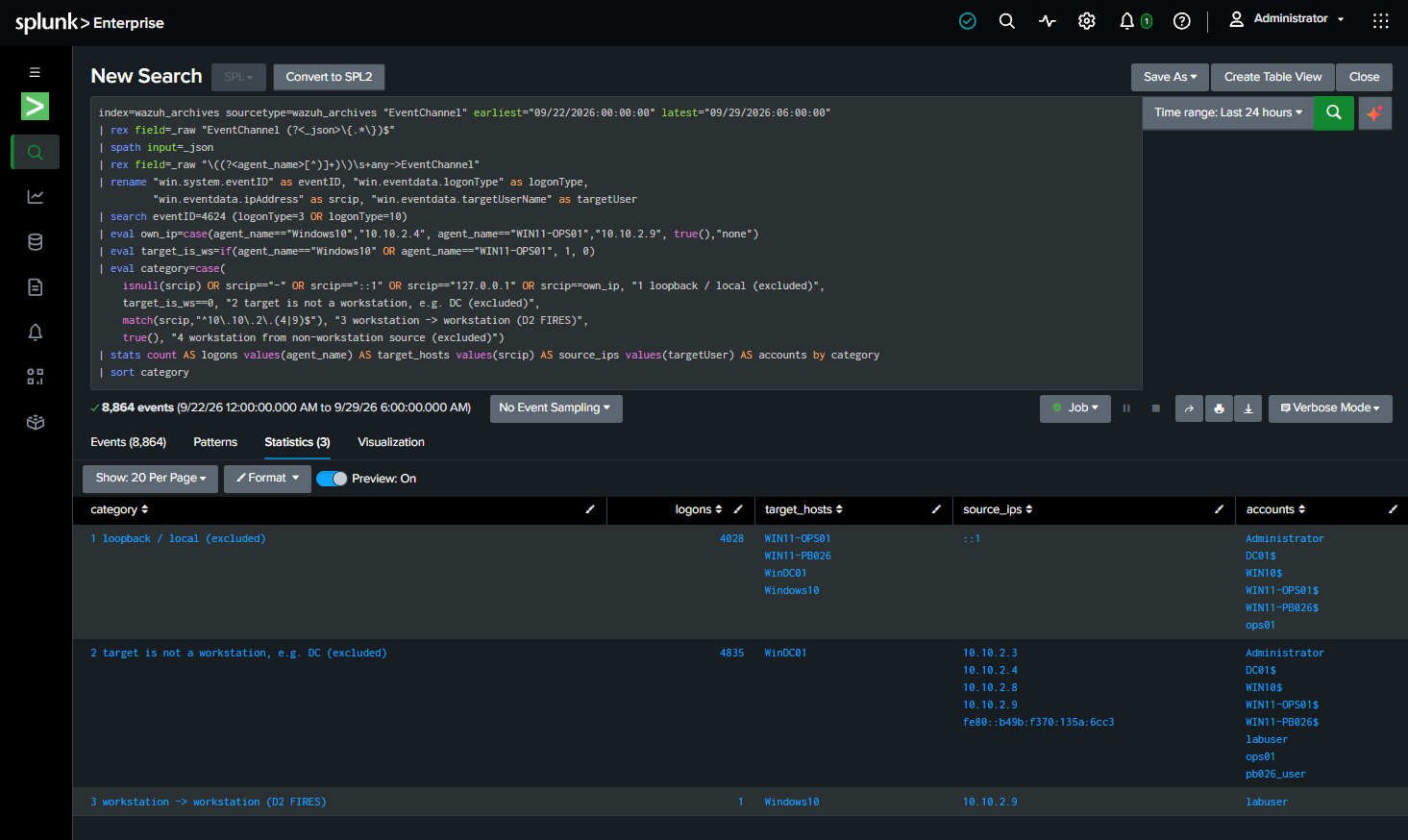
| Workstation → workstation hop invisible (OP-003) | D2 · network/RDP logon between peer workstations | Caught the OP-003 hop; of 8,864 logons in 7 days, the only match |
| Run-key alert misnamed "script host" (OP-002) | D3 · renamed "Run/RunOnce Key Modified", shows the real writer | Logic unchanged; original kept disabled for rollback |
3. The blind re-run (2026-09-30)
To check the fixes without bias, techniques were run from an opaque token kit and investigated cold: consoles only, no operation docs, with a benign decoy mixed in. Then the tokens were revealed and scored.
| Token | Technique (revealed after) | Detected? | Time to detect | Before OP-004 | Now |
|---|---|---|---|---|---|
| a9 | Decoy: Get-Service, gpupdate (normal admin) |
Correctly not alerted | n/a | n/a | No false positive ✓ |
| p7 | Lateral logon net use \\10.10.2.4\IPC$ (T1021.002, T1078) |
Yes | ~25 s (Wazuh logon) · ~6 min (D2) | 🟥 Missed | 🟩 Alerted |
| k2 | Discovery burst (T1082, T1057, T1033, T1016, T1018) | Yes | ~5 min (D1) | 🟥 Missed | 🟩 Alerted |
| c1 | Collection off the decoy folder → loot.zip (T1005) |
No, archive logs only | n/a | 🟨 Logged-only | 🟨 Logged-only (next: D4) |
| x8 | Run key via PowerShell (T1547.001) | Yes | seconds (510150) · ~3 min (D3) |
🟩 Alerted | 🟩 Alerted |
| m4 | Run key via reg.exe (T1547.001) |
Yes | seconds (92302) · ~2 min (D3) |
🟩 Alerted | 🟩 Alerted |
4 / 5
techniques found cold, with no help from the attack plan
0
false positives: the decoy was correctly ignored
2
former misses now alerting (discovery, lateral hop)
~2–6 min
time to detect for the scheduled correlations (seconds for real-time Wazuh rules)
The one remaining miss, collection outside the decoy folder, is the next detection (D4). Time to detect is bounded by the 5–10 minute schedule of the Splunk correlations; real-time Wazuh rules alerted within seconds.
What I'd do next
- D4: collection and staging beyond the decoy folder (staging folders, bulk copies, zips in temp).
- Beaconing and egress anomaly detection for sustained C2 and exfiltration to unknown addresses.
- Tune the noise floor: the rules that buried real alerts under ~1,457 low-value alerts in two hours.